Birds
Sandhill Crane

The Sandhill Crane and their form of living. The Sandhill Crane is a species found in North America and northeastern Siberia. There are a few other subspecies that reside in the Gulf Coast of the U.S., Florida, Georgia, and Cuba. The northern populations are larger and are seen in Canada and Russia. These migrate to the southwestern United States and Mexico. Up to 450,000 cranes migrate annually, which is probably the reason I was able to locate a group of about twenty of them back in January. They stopped at a newly planted field looking for food, and only stayed a few hours before taking off and continuing their migration. Although many Sandhill Cranes migrate there are some species that don’t. The reason for many bird’s migration is often either resources, water, breeding season, or the most common: weather. Many times, it is a combination of two or more of these reasons why cranes continue to migrate year after year. When they are born, Sandhill Cranes are white and brown in color and it is not until they are nearly adults that they start changing into their vibrant red, gray and black colors.
Name of Birds
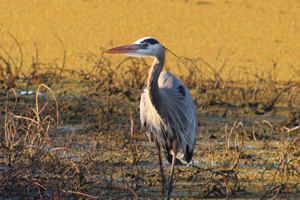
This amazing bird can be spotted in most of North America, and during the summer season as far north as Alaska and the southern provinces of Canada. During the winter months, the variation of groups spread south through Florida, the Caribbean, Mexico, and into South America. These beautiful birds prefer warmer weather, and they often migrate to warmer climates, unless they already live there. The Great Blue Herons that live east of the Rocky Mountains, spend their winters in the southern states of the United States, or they fly to further coastal countries. Nevertheless, their resilience can be shown as some individuals stay during the cold (and sometimes long) winters, especially if there is enough fish or food to eat. These birds are quite adaptable in most wetland conditions. The Great Blue Heron can be found in surprising numbers in fresh and salty waters, as well as in swamps, lakes, and meadows. Great Blue Herons are seldom seen far away from bodies of water, although one may spot them flying over open field areas. Strange as it may sound, and particularly given the size of these birds, they nest in tall trees to prevent predators. They find isolated places where they know their babies can grow into adults safely. When trees are not available, they nest in bushes or on the edges of lakes.
The Great Horned Owl

The Great Horned Owl can be distinguished by its plumage called the plumicorns, which look like horns on top of their heads. Although they look as if they were ears, they are neither horns, nor are they ears. This bird of prey is native to the Americas and can be spotted throughout the entire American continent. From cold weather in Canada and Alaska, all the way down to tropical weather in South America. It tends to adapt easily to its environment. Its primary diet is smaller animals, such as rats and rabbits, although it is strong enough to eat smaller mammals, including rodents, small mammals, and other bird species. The great horned owl shares similarities to other birds of prey, such as the red-tailed hawk, and they have similar diets. They are about two feet tall, and their wings when spread are four feet long.