(i)Nature- eco-centric landscape solutions

Moises Castillo

mmc.ca.usa@gmail.com (encoded so you don't get spam)

(i)Nature Project- Overview

(i)Nature is a mobile application for users to learn what native plants, trees, or shrubs are in their area. Native plants, trees, or shrubs provide ecological benefits to provide a more robust ecosystem for their home or community by planting them at their residence. The user would enter their zip code, and (i)Nature would provide the native plants, trees , or shrubs options in their area. Native plants, trees, and shrubs are beneficial to create a habitat for drought tolerance and are H.O.A. approved, and require less maintenance and water.

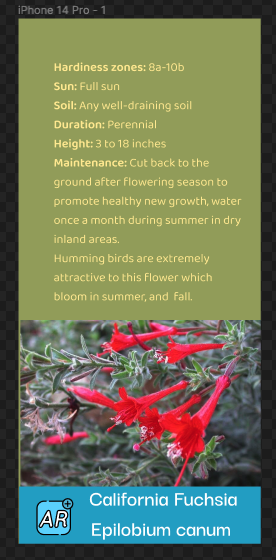
(i)Nature has an augmented reality feature to visualize how a native tree, plant, or shrub would look in their yard. A description of the native plant, tree, or shrub would be available. For example, California Fuchsia attracts hummingbirds and other pollinators, such as; bees. They grow well in Hardiness ones 8a-10b and offer a beautiful red trumpet-shaped flower.

Users can visualize a space in their yard to find out what plant, shrub, or tree would fit best. The (i)Nature app could create easier access to information to beautify your residence, save water, and build an ecosystem that supports mother nature. The target audiences are millenials and Gen-X.

Project Research

The research started with a prompt using the word equity. I had come up with various ideas, and I finally decided with topic of ecological restoration.I wanted to give voice to the voiceless and ecological restoration was a good fit. However, the science of ecological restoration for it to be effective requires ongoing data by users and then scientists to scrub the data for analysis. I finally decided to narrow the scope of ecological restoration to people's places of residence where they can create their own native garden.

The application presents ideas that create a native ecosystem in their yard by planting directly in the ground or using pots. This way (i)Nature is centered around the idea of ecological consciousness and enhancing your living space with native plants that will be beneficial to your local ecosystem. Thus, the research shifted from science-based to informational, where the users will learn what plants, trees, or shrubs can be used to create a living space with eco-centric design. Providing details of what plant life will encourage pollinators, pest control, floral aroma, etc.

App Design

I wanted the App design to offer a fun intuitive interaction with curvilinear font for clear contrast to the paragraph text. The color palette is earthy and grounded with simple color patterns perhaps like a retro video game.

After some peer feedback, I decided to heed the advice to left align and provide a background color to some of the application windows. It proved useful as to help with eye flow without breaking any huge design pattern principles. I would have to take a lot more into the design configuration should I want to attempt to publish it according to Apple design manual.

Tasks For Users

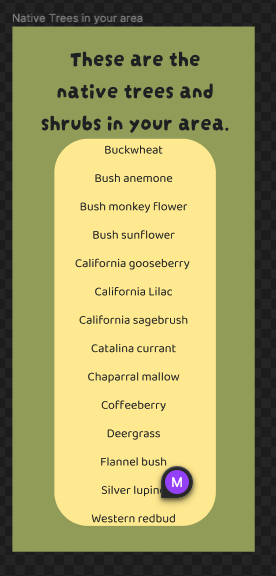
The user tasks are simply to enter in their zip code to obtain a list of Native plants in their area. The list populates a list of plants, trees, and shrubs. The user selects an list item and the app will provide a picture and short description of the selected item.

The selected item will have a AR+ button to allow the user to view the selected item in this case a California Fuschia to appear in their yard.

The user can then x out of the screen which will direct then back to the list of trees, shrubs or flowers. The user can then have the option to x out of that screen to go back to the zip code screen to select another zip code.

  1. Select zip code.
  2. Choose plant, shrub, or tree for more information.
  3. Read and view the item choosen.
  4. Press the augmented reality feature to view in your yard.

Usability Testing & Further Development

Users appreciated the idea of getting information about the various ways they could learn about various native plants, trees, and shrubs in their area. However, when it came to actually showing what the augmented reality view would look like it sort of fell flat.

The screen size for the prototype was for an iPhone 14 max. This did not leave very much screen room to Layout a clear picture of what the selected plant, tree, or shrub would look like in realistic situation with regards to scale and proportion. This application idea would be better suited for a tablet that can afford more screen to measure up a realistic expectation of what the selected native plant, tree, or shrub would look like. At this point, I would consider re-designing for a tablet and then perhaps an optimized version for smaller screen such as a smart phone.

Summary

This project taught me some of the vocabulary for ecosystem restoration and the scientific applications that use this type of model for long term data, such as, I Naturalist. I learned about I Naturalist about halfway through my research with this project. I discovered I Naturalist consisted of a large team funded by various organizations

The most challenging for me was to learn the vocabulary needed to do effective research. The most rewarding aspect of this project is that I will now look at different types of native plants at local nurseries to enhance my yard and create an eco-friendly design to enjoy. I also feel this may be a worthwhile tool for landscape designers/ salesmen to use while consulting with clients. A great tool to show immediately what options are available to make real life comparisons in their yard.

In hindsight, I believe this maybe a worthwhile application to prototype further as to have a ready example for a developer to create an experimental version for further testing. I am starting to see how certain homes in neighborhoods are using drought tolerant landscapes that look beautiful and add a distinct design to the home. This maybe a valuable resource for government agencies looking to incentivize drought resistant landscapes in urban or suburban communities.