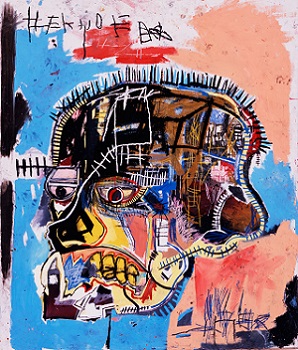
Untitled (Skull) by Jean-Michel Basquait
Personal
I really like the painting. I love the chaoticness of it, while still having solid visual elements. I like that it mainly uses primary colors offset with peach and gold. The eyes give it a very emotionally heavy look, as if the person depicted, or person painting this, is being weighed down mentally. I am curious about many of the elements used throughout the painting, such as what appears to be writing in the top left and bottom right, the blue where the left half of the teeth would be, and the white rectangle in the top middle of the head.
Cultural
Basquiat had an ongoing theme surrounding the reclamation of his African heritage and was known to depict skulls and heads in his work influenced by masks, potentially traditional voodoo masks given his Haitian dad who practiced voodoo. However many have also said he was inspired by the Gray’s Anatomy book his mother gave him when he was hospitalized at 7 after being hit by a car.
Technical
This painting was made using acrylic paint and crayon on canvas. I wish I could see this painting in person and get a better idea of where the crayon was used. Basquiat was said to use “expressive and at times violent brushstrokes” to create his works, which can be seen throughout this piece. He appears to use long, definitive lines to separate different anatomical parts of the skull, such as the mouth and the nose, while using more scattered lines and patterns to fill in the blank space. It also looks like differences in colors were used as shading.
Historical
Basquiat worked on this piece from 1979 until 1981 when he completed it. This was uncharacteristic of him because he was known for completing his works very quickly. Many have speculated as to why this piece took so long, those close to him believe he was caught off-guard from the power emanating from it. Others believe it was due to the pressures of becoming famous. Graffiti art was very popular during the time Basquiat worked on this piece, and is the form of much of his early art, and likely inspired the style of this painting. Socioeconomic tensions between classes were high, as was racism, during the time Basquait painted this. While there were some civil rights advancements happening during the 1970s, there was not much economic improvement for many Black folk. These tensions influenced a lot of his work, and likely played a role in this piece as well.
Ethical
I can not find or think of any ethical issues with this piece of art.
Design
Basquiat used many colors in this piece but primarily black, red, yellow, blue, and peach. This is a mixture of both warm and cool colors. The background mainly consists of blue, giving a calm, yet possibly sad, emotion. The black takes up a good portion of the face, possibly resembling Basquait, as many have said this was a self-portrait. The mixture of all the colors together inside of the head makes it seem like he had a mixture of emotions going on. Many lines are used throughout the piece, further giving a sense of jumbling, constantly moving thoughts.While it can be easy to get lost in the painting, the long, solid lines allow a path for our eyes to take. Due to the style of his art, there are not a lot of solid areas of color, allowing the viewer to see lines and colors painted over each other. This gives the piece a lot of depth, giving the left side of the head, which more closely resembles a living person and skin, a sense of being in the forefront. This sense of depth almost makes it look as if you were looking inside of his head as well as creating a dichotomy between internal thoughts and external expression and between life and death.
Critical
Now that I have had more time to look at and read into this piece, I have developed a lot more appreciation for it both technically and emotionally. It is clear that so much thought went into this piece and that he was giving the viewers a look inside his mind. Someone could look at a person with a similar external expression on their face and make judgements while having no idea what is really going on internally. It shows that you never know what someone is going through. It also portrays the balance of life and death and that we are all, in some way, in between the two, that they are closer together than many of us would like to think. Many are likely to glance at this piece, see the style of it, and look on; I think if it is given the chance to really be observed, the meaning comes through very effectively.