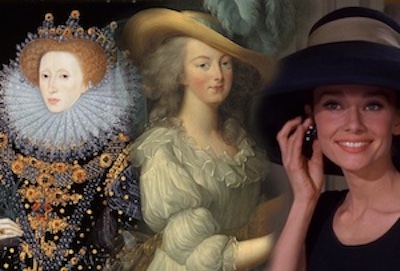
Fashion Through History
Introduction
As it is known, fashion has been constantly evolving since the start of time. Fashion first started the moment that humans started wearing clothes.
Back then, clothing was primarily constructed from animal skins and bones. We can learn a lot about humans by the clothes that they wear.
Fashion is heavily influenced by environment and current events. Believe it or not, there are still many elements of ancient dress that still influence our clothing today in some shape or form. Here is a brief overview of some key moments in fashion history.
Jump to...
The Sheath Dress
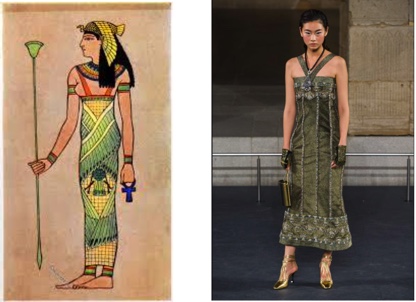
The sheath dress stems from ancient Egyptian times. The bodice is very slender and conforms close to the body. Scholars are uncertain about the techniques used to decorate the fabric of sheath dresses, which were often elaborately patterned. Speculations include painted designs, appliques, feathers, leather, beadwork, and woven designs. (Modern dress shown to the right is Chanel Pre-Fall 2019).
Historic Description
- Dress is form fitting to the body, most likely made of linen
- May have had a bead-net over the linen to better conform it to the body (grid-like detail on top and bottom of the dress)
- Two straps connect the dress over the shoulders
Modern Description
- Fabric is stiff and has a glimmer to it
- Applique is embroidered and beaded on top and hem of the dress, with striped features coming down the entire bodice of the dress
- Two straps hoist the dress over the shoulders, coming to a more dramatic v shape in the front
Historic Wear
According to historians, there is no actual artifact of a sheath dress to physically study. However, there are multiple depictions in Ancient Egyptian illustrations such as the one featured above. From the detailed illustrations, it is safe to speculate what these dresses may have featured, like beads, appliques, bead-nets, etc. According to the text, these sheath dress garments were among the most complex of the time. There is no clear indication of who would’ve worn this dress, but it is my opinion that it would have been worn by wealthier women with status.
Popularity Today
I believe that the fascination with Egyptian designs and aesthetic will always be a popular element in fashion. Egyptian dress is so simple, yet the designs are so complex. This sort of idea in fashion is very popular and the simplicity gives the ability to direct the eye towards the fabric type and certain details like colors, patterns, cut, accessories, beading, etc. The ‘exoticness’ of ancient Egyptian dress will always be fascinating in the world of fashion, and that is why it is frequently revisited, in my opinion.
The Fitted Dress
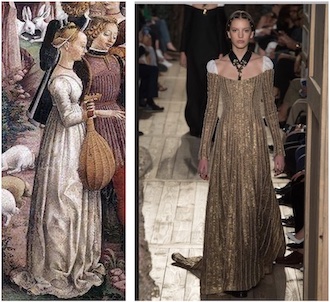
Fitted dresses of Italy in the 1300s-1400s were very popular at the time. The lowness (or highness) of the neckline was dependent on the age. Some dresses featured sleeves that reached to the elbow, some that reaches to the wrists, and some had no sleeves at all. Square necklines were extremely popular and sometimes sleeves were so tight that slits had to be cut near the elbows. By the second half of the century, women revealed their shoulder and necklines. The gowns were smoothly fit through the body and featured tight-fitting, long sleeves. (The dress featured is Valentino Fall 2016 Couture).
Historic Description
- Dress is made of flowing, draped material
- Neckline is low, yet still wraps around the shoulders
- Woman most likely wearing a camicia underneath her dress
Modern Description
- Fabric is stiff and structured near bodice, yet flowing towards bottom
- Camicia is seen peeking underneath the dress and on the shoulders
- Small gold embellishments stripe down the entire dress
Historic Wear
This dress was worn by upperclass women in medieval era Italy and France. As the style evolved, the cut became more tailored and the bodice fitted the body more closely.
Popularity Today
I believe this style re-emerged because the neckline is so feminine and grand. The modern styling and innovation in fabric means that this gown can be made in a much more comfortable way than the fabrics and cuts of earlier times. The revealing neckline accentuates the collarbones of the woman wearing the style, and the tight-fitting sleeves and bodice really give a tapered look.
Edwardian Dress
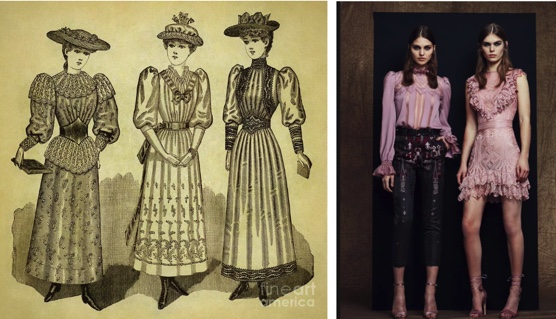
Edwardian styles placed a big emphasis on S-shaped silhouettes. The Edwardian period saw the revival of the empire waist, which was seen in most dresses’ waistlines. Typucal dresses featured high-boned collars and full, pouched bodices. After hugging the hips, skirts flared out to a trumpet shape at the bottom. There was an emphasis on frilly and much-decorated clothing that required soft fabrics. Decorations included tucking, pleating, lace-insertions, bands of applied fabric, lace, and embroidery. Frilly ruffles, called jabots, were often placed at the front of the neck. Bishop sleeves were very popular. The bishop sleeve was gathered into the armscye and full below the elbow with fabric puffed or pouched at the wrist.
Historic Description
- High, collared neckline
- Bishop sleeves end in tight, wrapped cuffs
- Belted band brings dress in, while skirt brings it flowing back out
Modern Description
- Thin, light, flowing fabric that contains sheer details
- High-neck collars, some ruffled
- Lace detail at top/chest area
Historic Wear
This dress was originally worn by middle-class to upper-class women. However, the invention of the sewing machine and the industrialization of the time made these ready-to- wear outfits easier to afford by many. Separate blouses came in a great variety and displayed features much like the bodices of daytime dresses. Mail-order catalogues advertised a wide range of skirt styles with which these blouses were worn.
Popularity Today
I believe this style is frequently re-introduced because it is extremely classy, elegant, and sophisticated. The Edwardian era debuted just over a hundred years ago, so the style is still greatly featured in women’s modern dress, especially in workplaces like the office. The style is intricate, the lace is delicate, and the high-neck is sophisticated.
The Miniskirt
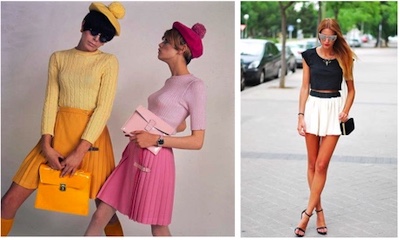
A miniskirt is defined as a skirt that features a hemline above the knees, usually hitting around the mid-thigh area. It wasn't until the 1960s that the emergence of the miniskirt caused widespread popularity. Miniskirts have existed in some ancient cultures, but generally it is believed to have become a widespread phenomenon after many different fashion designers of the 1960s created their own versions. Miniskirts are now a staple in the closets of many and regularly reemerge in popularity every decade.
Historic Description
- Knife pleats featured along entire skirt except front
- Skirt hem hits slightly above the knee
- Waistband/skirt fastened by top button
Modern Description
- Mid upper thigh length
- Elastic waistband provides comfort and an easier fit
- Flowy, slinky fabric, possibly a cotton polyester blend
Historic Wear
Young baby boomers who were coming into their own and embracing the sexual revolution that came about at the time. These women were trendsetters, concertgoers, and spent their time on the streets mingling with others. They were most likely from London but could be from France or America as well.
Popularity Today
After the 60s, this style went away for a little while but re-emerged in the 80s/90s and hasn’t gone away since. To me, the miniskirt is the embodiment and essence of femininity. The miniskirt is very flattering and simple to pair anything with. Miniskirts look great with heels, oxfords, boots, flats, sandals, and so much more. The miniskirt can so easily be dressed up or down for a casual look.