Neville Brody

Neville Brody, A British Graphic Designer, Typographer, and Art Director, is seen as one of the most talented Graphic designers of his generation.
Brody, who studied at the London College of Printing in the 1970’s, made his first mark as a graphic designer in the 1980’s designing record label cover designs and making art for “the Face” Magazine. Brody’s work at “The Face” magazine established his reputation as one of the world’s leading Graphic Designers and also revolutionized how designers and readers approached the medium in the 80’s (Hooper) In 1988, Brody’s work was published in Thames & Hudson’s part 1 of a two-volume book called “The Graphic Language of Neville Brody”, which became a best-seller world-wide. (“Neville Brody” 2) Despite making a huge name for himself in the 1980’s and 90’s Brody’s recent work also includes a rebranding of BBC in 2011, and redesign of the Times’ typography in 2006, and on screen Graphic for Paramount Studios. (“Neville Brody 4)) Brody also went on to design for many other magazines, and big name brands such as Samsung, Nike, Yamaha, Paramount Studios and much, much more. (Butler) Brody also founded the London based type foundry “Fontworks” and has designed over 20 different typefaces. (“Neville Brody 4) Among the typefaces he created were the very well known “FF” typefaces. Brody was referred to as the “star typographer.” (Hooper)
Neville Brody Studio
In 1994 Brody established his own Graphic Design studio, called “Neville Brody Studio”, which has since been re-named “Brody Associates”, and serves clients on a much larger scale internationally (“Neville Brody” 2, “Neville Brody 4). However, Brody was sharply against the idea of mass producing his product and unintentionally becoming “generic.” His intention was to produce his art on a more intimate, personal level and to never stop experimenting. In the interview with Design Boom magazine Brody described the economic downturn as a major reason that most designers stopped experimenting in which they “became quite comfortable simply conforming.” Brody stated it was “a case of style over substance, nothing was dangerously new, or provocative.” Over the years Brody’s studios popped up in many cities across the globe, including London, Berlin, Tokyo, Seoul, Paris, Berlin, New York, Barcelona, and more. Brody reiterated that these studios work on a human scale and that they have never had a large number of people working in each office. In the Design Boom interview Brody says,
"if you can't all go to lunch together then there's too many of you".
The Early Years
Brody considered himself an artist at a very early age, who stated in the interview conducted by Design Boom that he was drawing before he could even walk, and it became a challenge deciding whether he wanted to become a fine artist or a designer. Brody decided to go with Graphic Design because he saw the fine art industry as dishonest. He claims that fine art “pretends to be about culture but its really about money. Design is much more about it’s commercial context and can also reach a lot more people than fine art.” Brody also explained that he chose Design s a career because he had always been interested in how advertising and design can change the way people think and feel. Brody stated that he “wanted learn those tools in order to turn them around, to reveal the truth rather than conceal it.” Brody even goes further into introspection and reveals that when he was only 7 years old, he designed a complete identity system for an imaginary postal service!
Disruption and Re-imagining Design
Brody describes his work primarily as a way to communicate, and to understand and encode language, because it is always changing and it constantly needs to be managed. Brody is always trying to “challenge, rethink, or disrupt through graphic design.” And he always wants to keep his work fresh, and always tries his hardest to avoid a formulaic standard approach with his work. Neville has never committed himself to just one specific field. He has worked all across the board with branding, print, digital, and environmental design. (Butler)
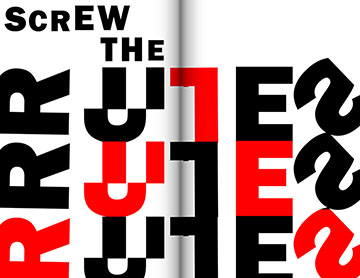
“challenge, rethink, or disrupt through graphic design."