
The Rock Lobster — Nephropididae Caputlapidis
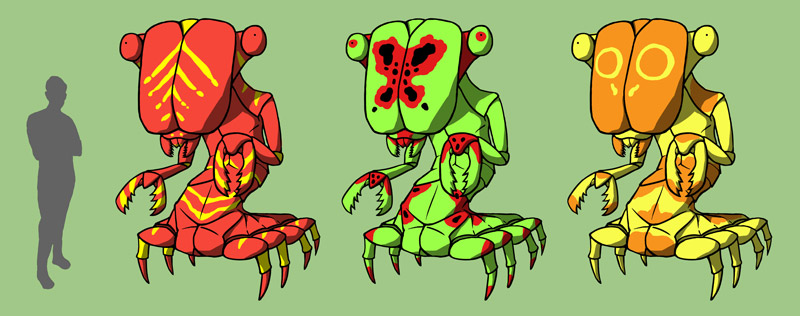
Each specimen of Nephropididae caputlapidis, or Rock Lobster, has its own unique coloration. Here are only a few of the many colorful patterns that a Rock Lobster can possess. Terran for scale.
- Common Name: Rock Lobster
- Average Height: 2.75 m
- Average Weight: 1200 kg
- Average Lifespan: 32.4 years
- Diet: Omnivorous
- Used in: Phantanmil™ and Jolivia™
The Rock Lobster — or Nephropididae caputlapidis — is one of E-40873's most colorful Magnisects. Standing taller than the average Terran, Rock Lobsters are easily spotted among E-40873's dense jungles because of their bright coloration. The bright patterns and color combinations are unique to each individual — no two Rock Lobsters are alike! Our Entomon research staff theorize that these patterns are used to ward off much larger predators. It's as if to say, "Watch out! I may be (relatively) smaller than you, but I'm dangerous!" Its powerful pincers are capable of crushing omni-steel spacesuits.
You may be wondering: why the name "Rock Lobster"? Members of N. caputlapidis have large, hard exoskeletal projections on their heads. During the mating season, males headbutt one another to assert dominance. This hardheadedness and the Rock Lobster's morphological similarity to the extinct Earth crustacean are the reasons researchers chose this moniker. Note that their eye-stalks are on the sides of the head, out of the way of injury from a rival.
Most importantly, Rock Lobsters produce enzymes that are useful in Entomon's patented pharmaceuticals Jolivia™ and Phantanmil™. It's no surprise that a headbutting Rock Lobster would be helpful in producing Phantanmil™ anti-migraine medication! In order to harvest these unique enzymes, Entomon team members must trap members of N. caputlapidis in the wild. Unfortunately, efforts to breed Rock Lobsters in captivity have been unsuccessful and have led to burdensome litigation.
Click here to return to the main portal and continue exploring new species!