THE
ONEIDA COMMUNITY
PART I
11/29/2017
United States History 17a
Contents
I–Introduction
If you were an American citizen in the early nineteenth century, the idea that man could form the perfect society would be far from a distant dream-- rather, it would be a legitimate possibility. Budding utopian communities began to spring up, prompted by the increased spirit of social change brought upon by new technology and revolutionary theological concepts. Each community went about tackling perfection in very different ways, the strangest arguably being the Oneida Community, founded in upstate New York by charismatic leader John Humphrey Noyes in 1848. It was, for a time, incredibly successful, but slowly this “heaven on earth” became increasingly hellish. The true cause of its ultimate demise is a question yet debated by historians, many choosing a single issue out of many as being solely responsible. However, it was not one but many internal and external issues, ranging from failed eugenics experiments to accusations of polygamy, that lead to the Oneida Community’s transformation in 1880 from religious cult to multinational silverware conglomeration.
II–Background and Founding
Even as a young boy John Humphrey Noyes was described by the clergy to his mother as being “like God”, his powerful charisma making him a “Leader and Commander” to the people, destined to lead his followers and bring God’s kingdom upon the earth (qtd. In Olin 288). He thrived under such daunting expectations, graduating from Yale Theological Seminary and developing his own unconventional (and more than a little irrational) take on scripture: that Christ had already returned in A.D. 70, thus everyone had already been redeemed and that it was entirely possible, if not necessary, to achieve complete perfection including “salvation from sin… disease, and death” (qtd. in McGee 319). His views were deemed heretical, and his preaching license was revoked, but that only prompted him to intensify his “mystical” and “philosophically profound” teachings, his charisma easily drawing disciples while in Putney, Vermont. In a prophetic turn of events he and his followers were expelled from Putney with threats of arrest, as they had begun practicing rudimentary versions of Noye’s ideas such as Complex Marriage, drawing hatred and accusations of adultery from the outside community.
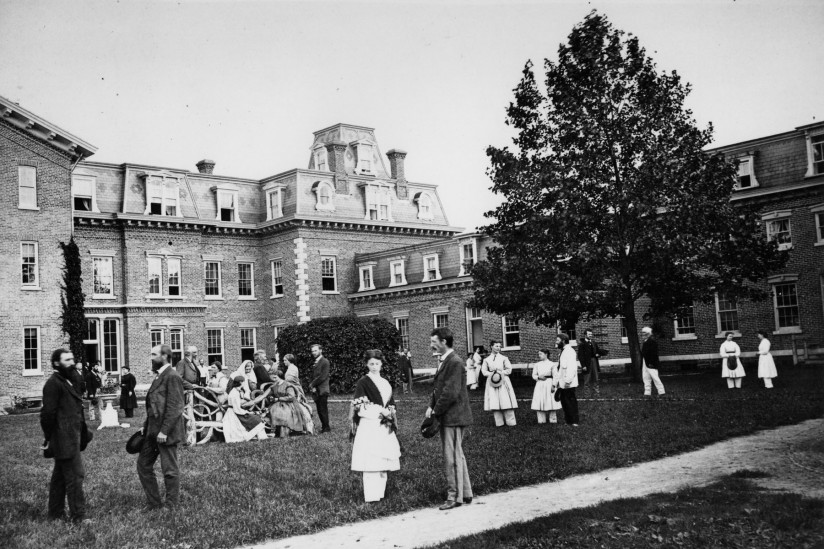
They regrouped in 1848 in Oneida, New York and founded the Oneida Community with only 87 members. Here they constructed the Mansion House, which grew over time along with the community’s membership. The lives of community members within the Mansion house were surreal, within its walls “the totality of their existence lay” (McGee 262), with little knowledge and constant wariness of “The Outside”. Noyes’ himself stated he strived to create an “absolute monarchy”, dismissing democracy as having “no value whatsoever” within his “thoroughly regulated family (qtd. in Olin 289-290). Oneida had no formal constitution nor written laws, Noyes instead relying on the undefined “rule of grace” to govern his community. There existed a system of Ascending Fellowship based off of member’s level of spirituality, at the top of which was himself, serving as “the medium of grace” for all (Olin 289). It’s not hard to see some of the ways Oneida was doomed from the start. They had already developed negative relations with the outside world which had ended in small-scale expulsion, a clear warning that Noyes entirely ignored. Noyes’ own charismatic leadership style and hierarchy system put him alone at the community’s core and gave himself almost god-complex levels of importance, influence, and control. The fact that he was entirely irreplaceable coupled with his distaste for actual law would play a crucial role in Oneida’s downfall.
III–Life Within the Community
Many strange practices were observed in Oneida with varying degrees of success. It enacted a form of economic communism taken to the social extreme, under which virtually all community activities were “designed to accentuate the we rather than the I”. In Noyes’ eyes, “selfishness” was the ultimate sin, and it was suppressed in every possible way. Any kind of private property was “taboo”, down to children’s toys. In fact, when the little girls of the community began spending too much time playing with dolls instead of each other, dolls were not only banned, but “all the girls joined hands in a circle around the stove, and one by one were persuaded to throw their dolls into the fire” (Kephart 263).
Although the community was economically successful, Noyes still wasn’t satisfied with the community’s altruism, so he enacted a system of Mutual Criticism to weed out and destroy any illegal attitudes. Members on “trial” were put under the “verbal scalpel of Noyes” and other members, finding their “most prized virtues… dismissed as faults”. It was described as “painful and more than mortifying” (Parker 215-216) by members, yet ironically used as a method of healing in the incredibly abnormal practice of Krinopathy. When a “severe epidemic of colds” broke out in Oneida’s nursery, “ailing children were counseled to confess Christ as their physician, and invite criticism as their medicine” (Parker 219). Although members claim Mutual Criticism never caused them to harbor resentment between each other, it nonetheless appeared that way from an outsider’s perspective. As the New York Times put it in their article on the subject, “Noyes… recogniz[ing] the fact that he could bind his followers together by the bond of hate stamps him as a man of real, if perverted genius” (qtd. in Parker 220; emphasis added). Overall, the practices of social communism and Mutual Criticism served to provide an almost traumatic state of living and harbor resentment from the “Outside”, if not inside the community itself.
This article continues in The Oneida Community Part II.